

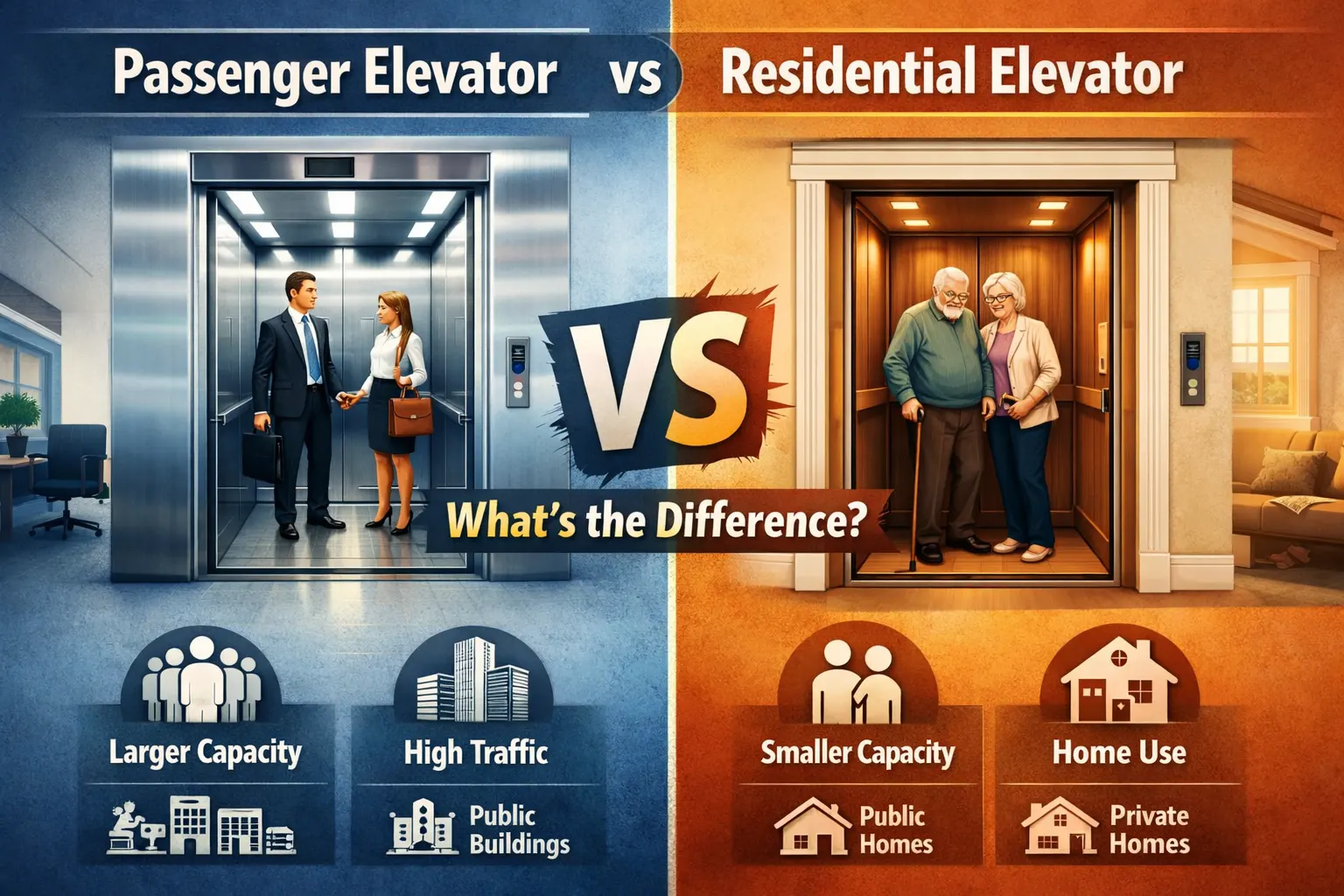
Passenger Elevator vs Residential Elevator: What’s the Difference?
Many building owners compare elevator prices before they compare elevator purpose. That usually leads to the wrong system being selected—especially in villas, duplexes, and low-rise apartment projects where space, user traffic, and ride expectations are completely different.
A passenger elevator and a residential elevator may look similar from the outside, but they are built for very different purposes.
One is designed for shared or commercial use. The other is made for private home use.
If you are planning a building, villa, apartment, duplex, office, or commercial project, understanding this difference can help you avoid a costly mistake.
In this guide, you will learn:
what each elevator type means
how they differ
Which one suits your building best?
What to consider before buying
By the end, you will have a clear idea of which lift is right for your project.
What Is a Passenger Elevator?
A passenger elevator is a lift designed to carry people in commercial, public, or shared residential buildings.
It is built for frequent daily use and can handle more traffic than a home lift.
Passenger elevators are commonly used in:
office buildings
shopping malls
apartment complexes
hotels
hospitals
schools
commercial buildings
Main features of a passenger elevator:
higher load capacity
faster performance
durable components
larger cabin size
frequent operation support
In simple words, a passenger elevator is built for multiple users and heavy daily movement.
What Is a Residential Elevator?
A residential elevator is a lift designed for private home use.
It is made for comfort, convenience, accessibility, and easy movement inside a house.
Unlike commercial lifts, a residential elevator is built for light daily use and a more personal environment.
Residential elevators are commonly used in:
duplex homes
villas
private houses
luxury residences
townhouses
low-rise homes
Main features of a residential elevator:
compact design
quieter operation
home-friendly interior
smooth ride quality
space-saving installation options
A residential elevator is ideal for homeowners who want better accessibility, comfort, and long-term convenience.
Passenger Elevator vs. Residential Elevator: The Real Difference
At first glance, both lifts move people from one floor to another.
But the real difference is in how they are used, where they are installed, and what they are designed to handle.
Let’s break it down clearly.
1. Purpose and Usage
This is the biggest difference between the two.
Passenger Elevator
A passenger elevator is made for shared buildings where many people use the lift every day.
It works best in:
commercial buildings
apartment buildings
institutions
hospitals
hotels
Residential Elevator
A residential elevator is made for private family use.
It works best in:
villas
duplex homes
private residences
low-rise houses
Quick takeaway
If your lift will serve many people, choose a passenger elevator.
If your lift will serve one household, choose a residential elevator.
2. Load Capacity
Load capacity plays a major role in elevator selection.
Passenger Elevator Capacity
Passenger elevators are designed to carry:
more people
heavier loads
repeated daily traffic
This makes them suitable for buildings with higher usage demand.
Residential Elevator Capacity
Residential elevators are designed for:
fewer passengers
light household movement
family use
They are usually enough for:
2 to 6 passengers
daily movement between floors
groceries, luggage, or personal items
Why it matters
A low-capacity lift in a high-traffic building can cause the following:
waiting time issues
faster wear and tear
poor user experience
3. Cabin Size and Design
The cabin experience is very different in both lift types.
Passenger Elevator Cabin
Passenger elevators usually focus on:
practicality
durability
larger user capacity
easy maintenance
They often use strong materials and simple finishes built for long-term heavy use.
Residential Elevator Cabin
Residential elevators often focus more on:
comfort
appearance
style
interior matching
Many home elevators allow customization in:
wall finish
flooring
handrails
lighting
control panel style
Best choice
If you want a lift that blends beautifully with home interiors, a residential elevator is often the better fit.
4. Installation Requirements
Not every lift fits every building.
This is one of the most important things buyers overlook.
Passenger Elevator Installation
Passenger elevators often require the following:
larger shaft space
stronger structural planning
more technical preparation
support for frequent operation
Depending on the system, they may use the following:
traction elevator systems
machine roomless (MRL) elevator systems
advanced control systems
Residential Elevator Installation
Residential elevators are often designed for:
smaller home layouts
limited installation space
low-rise structures
easier home integration
Many home lift systems are built to reduce the following:
shaft space needs
machine room requirements
construction disruption
Important note
Before choosing any lift, always check:
shaft size
pit depth
headroom
number of stops
building layout
A lift should match the building, not just the brochure.
5. Speed and Travel Distance
Not all buildings need the same elevator speed.
Passenger Elevator Speed
Passenger elevators are usually designed for:
faster vertical movement
higher floor travel
smoother user flow in busy buildings
This is especially useful in:
apartment towers
offices
hotels
hospitals
Residential Elevator Speed
Residential elevators usually operate at a more moderate speed because of the following:
travel distance is shorter
traffic is lighter
Comfort matters more than speed.
Practical answer
If your building only has a few floors, you may not need a faster commercial-style elevator.
6. Safety Features
Safety should always come first.
Both elevator types must include reliable safety systems. However, the safety setup may differ based on the usage environment.
Passenger Elevator Safety Features
Passenger elevators often include:
overload protection
automatic rescue device (ARD)
emergency alarm
door safety sensors
interlocking door system
emergency lighting
backup power support
brake safety system
Residential Elevator Safety Features
Residential elevators may include:
door sensors
emergency stop button
battery backup
smooth start and stop
easy access controls
cabin alarm
Smart buyer advice
Never choose a lift based only on looks.
Always ask about:
safety features
control system quality
after-sales support
emergency backup system
7. Daily Usage and Maintenance
A lift is not just an installation project. It is a long-term system.
Passenger Elevator Maintenance
Passenger elevators usually need more regular maintenance because they handle:
more users
more trips
more daily wear
This often includes:
routine servicing
inspections
preventive maintenance
spare parts support
Residential Elevator Maintenance
Residential elevators also need servicing, but daily use is usually lighter.
That often means:
lower wear and tear
easier maintenance planning
less stress on components
What to ask before buying
Always ask your supplier:
How often does it need servicing?
Are spare parts available locally?
Is after-sales support available?
These questions matter more than most buyers think.
8. Cost Difference
This is often the first question buyers ask.
Which one costs more?
The answer is simple:
It depends on the project.
The final elevator cost depends on:
number of floors
lift capacity
machine type
shaft size
cabin finish
control system
installation complexity
building condition
customization level
In many cases
Passenger elevators may cost more because they often require:
larger systems
stronger components
more advanced operation support
Residential elevators can also become expensive if you choose the following:
luxury finishes
custom cabin design
imported components
premium automation
Important
There is no fixed one-price solution.
A proper elevator quotation should always be based on the following:
your building type
your user needs
your available space
your technical requirements
Passenger Elevator vs Residential Elevator: Which One Is Best for You?
The easiest way to decide is to look at your building type and daily usage.
Choose a passenger elevator if:
Your building has many users.
The lift will run frequently.
You need higher capacity.
the property is shared or commercial
Best for:
apartment buildings
office buildings
hospitals
hotels
shopping centers
commercial complexes
Choose a Residential Elevator If:
The lift is for private home use.
You want comfort and convenience.
Your building has limited space.
The users are family members only.
Best for:
duplex homes
villas
private houses
luxury homes
accessibility-focused residences
Factors to Consider Before Choosing an Elevator
Before making a final decision, review these key points carefully.
1. Building Type
Is your property a home or a shared building?
2. Number of Floors
The more floors you have, the more performance matters.
3. Available Space
Check:
shaft space
headroom
pit depth
machine room needs
4. Capacity Requirement
How many people will use the lift at the same time?
5. Design Preference
Do you want:
practical durability?
premium interior finish
compact installation?
6. Budget
Plan your budget for:
installation
maintenance
future servicing
spare parts
7. Safety Standard
Never compromise on:
emergency systems
door protection
overload safety
control quality
8. Supplier Support
A reliable supplier should provide the following:
technical guidance
installation support
maintenance service
spare parts assistance
Benefits of Choosing the Right Elevator
The right elevator does more than carry people.
It improves how your building works every day.
Key benefits include the following:
better accessibility
smoother daily movement
improved safety
better comfort
stronger property value
lower long-term service problems
better user experience
Choosing the right lift from the start helps avoid future problems.
Common Elevator Buying Mistakes to Avoid
Many buyers make the same mistakes.
Avoid these common issues:
choosing based on price only
ignoring future maintenance
selecting the wrong capacity
overlooking building space limitations
focusing only on design
buying without checking support service
using a home lift where a passenger lift is needed
A lift is a technical system.
The wrong choice can become expensive very quickly.
Why Choosing the Right Elevator Supplier Matters
Even a good elevator can perform poorly if the supplier is weak.
A reliable elevator company should help you with:
site assessment
lift recommendation
building-based planning
installation support
safety checks
maintenance service
spare parts availability
That support is just as important as the elevator itself.
Frequently Asked Questions (FAQ)
Q1: What is the main difference between a passenger elevator and a residential elevator?
A passenger elevator is designed for shared or commercial building use, while a residential elevator is made for private home use.
Q2: Can a passenger elevator be used in a home?
Yes, in some cases. But it may not be the best choice for a private house if the traffic is low and the available space is limited.
Q3: Which elevator is best for home use?
A residential elevator is usually the best option for home use because it is built for comfort, compact spaces, and family accessibility.
Q4: Is a residential elevator smaller than a passenger elevator?
In many cases, yes. Residential elevators are often more compact because they are designed for home environments.
Q5: Which elevator is more expensive?
It depends on the building type, number of floors, capacity, design, and technical requirements. Passenger elevators often cost more, but custom home elevators can also be expensive.
Q6: What safety features should an elevator have?
A good elevator should include door sensors, an emergency alarm, overload protection, backup power, an emergency stop, and a reliable control system.
Q7: How do I know which elevator is right for my building?
The best way is to evaluate your building type, available space, expected daily traffic, and safety requirements before choosing a lift system.
Need Help Choosing the Right Elevator for Your Building?
If you are planning a new project or upgrading an existing property, do not choose blindly.
Get expert guidance based on:
building type
user traffic
available space
safety needs
long-term performance
Contact Merlin Tech Ltd today for professional support in selecting the right elevator solution for your residential or commercial building.